


Beyond Formulas: Challenging Strength of Materials Problems
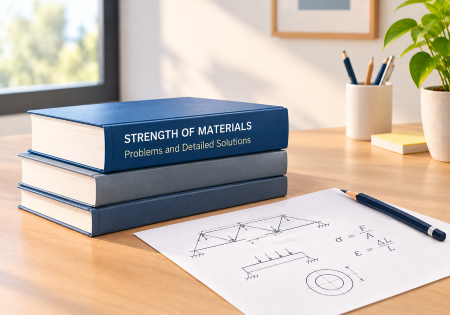
Strength of Materials is a fundamental engineering subject that requires more than memorizing equations and substituting numbers into formulas. A true understanding of the subject develops when students learn to analyze complex problems, establish appropriate mechanical models, apply equilibrium and compatibility conditions correctly, and evaluate their results from both physical and engineering perspectives.
However, some Strength of Materials problems are so challenging that even capable students may struggle to identify the appropriate solution method, determine the essential steps of the analysis, or arrive at the correct answer. Such problems often require multiple stages of calculation, careful examination of the given conditions, and the combined application of different principles of solid mechanics.
A student's ability to analyze and solve challenging problems correctly is a strong indication of a deep understanding of Strength of Materials. For this reason, access to accurate, detailed solutions to such problems can be particularly valuable for students, practicing engineers, and, above all, university instructors.
A Book for Tackling Real and Challenging Strength of Materials Problems
Strength of Materials: Problems and Detailed Solutions focuses on detailed problem-solving and covers a broad range of fundamental topics in Strength of Materials. A substantial portion of the problems in this book is drawn from exercises in the following well-known works:
- N. M. Belyaev, Problems in Strength of Materials
- I. N. Mirolyubov et al., An Aid to Solving Problems in Strength of Materials
These works offer valuable material for the in-depth study of Strength of Materials through their challenging analytical and computational problems. In the present book, the emphasis is on providing solutions that allow readers to follow the reasoning behind each problem and learn independently from the analytical process and calculations.
Solving some of these problems has required hours of analytical work and detailed calculations by the author. The value of this collection lies not merely in presenting final answers, but in providing a clear solution process for problems that students may find difficult to solve correctly on their own.
A particularly distinctive feature of Strength of Materials: Problems and Detailed Solutions is that the detailed solutions to these problems have been developed by the author and presented in this book for the first time. Some of the problems are exceptionally demanding from both analytical and computational perspectives, requiring careful, step-by-step investigation. The solutions represent the author's original effort to solve problems for which detailed solutions cannot be found in available references.
This makes the book especially valuable for students who wish to go beyond routine textbook examples and test their ability to solve demanding engineering problems. It also offers university instructors a useful supplementary resource for developing challenging assignments and examinations, assessing students' depth of understanding, and strengthening their problem-solving skills.
An Overview of the Book's Main Topics
The book is organized into eight chapters, covering a wide range of fundamental and more advanced topics in Strength of Materials.
1. Axial Load Effects in Determinate and Indeterminate Structures
The first two chapters cover truss analysis, axial stress and deformation, deformation compatibility, the effects of temperature changes and fabrication errors, and ultimate load determination. These topics help students understand not only equilibrium equations but also the role of compatibility conditions and the behavior of statically indeterminate structures.
2. Pure Shear Stress and Strain
Problems involving shear stress in connections and the design of shear connections illustrate the relationship between theoretical principles and practical engineering applications.
3. Analysis of Stress and Strain
This chapter examines uniaxial, biaxial, and triaxial stress and strain states, as well as plane strain. These concepts are essential for understanding material behavior under different loading conditions.
4. Bending Moment Effects in Structures
Topics include shear forces and bending moments in beams, section modulus and moment of inertia, normal stress determination, beam design, combined loading, and composite sections. The breadth of this chapter provides opportunities to practice multistep analyses and develop a deeper understanding of bending behavior.
5. Shear Stress in Members Under Bending Moments
The determination of shear stress in beams, principal stresses in beams, and the design of shear connections are among the topics that require an understanding of the relationship between stress distribution and the behavior of structural members.
6. Torsion Effects
This chapter examines the torsion of members with circular and thin-walled cross-sections, as well as members subjected to combined torsion and bending moments.
7. Stresses in Thin-Walled Shells
The final chapter focuses on stress determination in thin-walled shells, extending the scope of the book beyond conventional axial loading, bending, and torsion problems.
One of the book's educational features is the inclusion of dedicated Unsolved Problems sections throughout the chapters. These sections can be used for independent practice, self-assessment, and evaluation of a reader's ability to apply the concepts learned.
Why Is This Book Valuable for University Instructors?
For instructors teaching Strength of Materials at universities around the world, selecting appropriate problems is an important part of course design. Simple problems may test only a student's ability to apply a single equation directly, whereas more challenging problems can reveal a student's conceptual understanding, analytical ability, computational accuracy, and problem-solving skills more effectively.
Strength of Materials: Problems and Detailed Solutions can serve as a supplementary teaching resource for developing assignments and examinations. Depending on the course content and students' level of preparation, instructors can use its problems for several purposes:
- Selecting challenging exercises for university assignments.
- Designing examinations that assess students' ability to analyze problems independently.
- Providing additional problems for students who need more demanding practice.
- Comparing students' solutions with detailed worked solutions and examining their reasoning at each stage.
- Using multistep problems to distinguish between memorizing formulas and achieving genuine conceptual mastery.
The detailed solutions can help instructors review analytical procedures and calculations and, where appropriate, prepare supplementary teaching materials. Meanwhile, the unsolved problems provide opportunities to assign exercises or examination questions without immediately exposing students to the solutions.
As with any teaching resource, the selection of examination problems should reflect the course syllabus, students' level, available time, and intended learning outcomes. The book's value lies in offering a diverse collection from which instructors can select problems suited to their specific educational needs.
Who Can Benefit from This Book?
The book can be particularly useful to three groups of readers.
Engineering students: To practice challenging problems, strengthen problem-solving skills, and identify gaps in their understanding of Strength of Materials.
Practicing engineers: To review the fundamentals of stress and deformation analysis, reinforce analytical reasoning, and revisit solution methods in solid mechanics.
University professors and instructors: To find supplementary problems, develop assignments of varying difficulty, and prepare examinations that assess students' conceptual understanding and analytical abilities.
Conclusion
Mastery of Strength of Materials cannot be achieved by studying formulas alone. It develops through exposure to a variety of problems, careful analysis of their conditions, and sustained practice. Complex problems that require hours of analytical work provide valuable opportunities to develop these essential skills.
With eight chapters covering major topics in Strength of Materials and a collection of detailed worked solutions, Strength of Materials: Problems and Detailed Solutions offers a valuable resource for studying the subject in greater depth. Its original solutions to challenging problems make it particularly worth considering for students seekig to improve their analytical skills and for instructors looking for supplementary material for university assignments and examinations.
explore the book's details and consider how it may support your studies or teaching activities, visit the Strength of Materials: Problems and Detailed Solutions page in the EngiLib Engineering Digital Library.