


Earth Dam Analysis and Modeling Using GeoStudio
Introduction
Earth dams are among the geotechnical structures whose behavior is influenced by a combination of mechanical, hydraulic, and dynamic factors. The self-weight of the dam body, the strength and deformation characteristics of the materials, seepage conditions within the soil mass, pore-water pressure, and external loading all play important roles in the performance of these structures.
The engineering analysis of an earth dam is not limited to evaluating the factors of safety of the upstream and downstream slopes. A more comprehensive assessment of dam behavior requires examining stress and deformation distributions within the dam body and its foundation, seepage conditions, pore-water pressure distributions, and the structural response under different loading conditions. In seismic regions, dynamic analysis is also of particular importance, as earthquake-induced excitation can affect the stress state, deformation, and stability of the soil mass.
Numerical methods make it possible to investigate these phenomena by accounting for more realistic geometries, variations in material properties, and boundary conditions. Among the available tools, GeoStudio is a specialized software suite used in geotechnical engineering. It provides different analytical environments for investigating stress and deformation, groundwater flow through porous media, slope stability, and dynamic behavior.
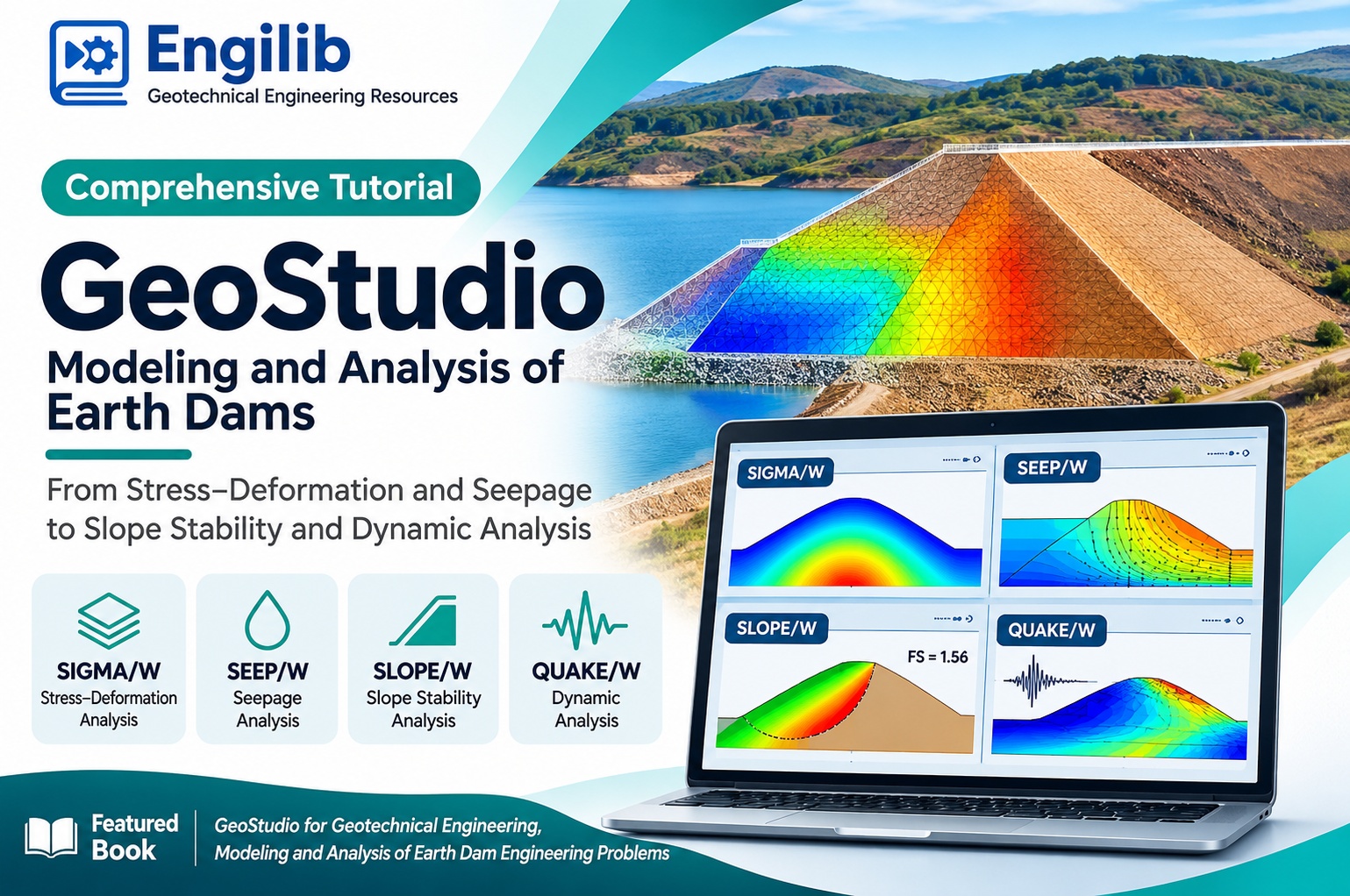
This article examines the applications of four major GeoStudio environments—SIGMA/W, SEEP/W, SLOPE/W, and QUAKE/W—in the analysis of earth dams. It also discusses the differences between homogeneous and heterogeneous earth dam modeling and the applicability of these analytical environments to other geotechnical engineering problems.
1. Stress–Deformation Analysis of Earth Dams Using SIGMA/W
One of the fundamental stages in evaluating the behavior of an earth dam is analyzing the stress and deformation conditions within its body and foundation. Following dam construction, the self-weight of the materials generates stresses due to dead loading, causing deformation within the soil mass. The magnitude and distribution of these deformations depend on the dam geometry, mechanical properties of the materials, foundation conditions, and load distribution.
In stress–deformation analysis, quantities such as principal stresses, shear stresses, displacements, and strains are examined at different locations within the model. These results help engineers identify how loads are transferred through the dam body, locate areas of stress concentration, and identify regions susceptible to significant deformation.
The SIGMA/W environment in GeoStudio is used for stress and deformation analysis in geotechnical problems. In modeling an earth dam, the cross-sectional geometry and different material zones are first defined. The mechanical parameters of the soil, boundary conditions, and computational mesh are then specified before the analysis is performed.
One important consideration at this stage is the selection of an appropriate constitutive model for the materials. The constitutive model should adequately represent the mechanical characteristics of the soil under the stress range and loading conditions being investigated. Inappropriate parameter selection or excessive simplification of material behavior can affect the accuracy of the results.
Stress and deformation analysis is not limited to earth dams. The same approach is also used to investigate embankment settlement, deformation of soil masses, the behavior of soil foundations, and various other geotechnical problems.
2. Seepage Analysis in Earth Dams Using SEEP/W
Seepage through the dam body and its foundation is one of the factors that determine the hydraulic behavior and stability of earth dams. Differences in hydraulic head across the dam create flow conditions and influence the distribution of pore-water pressure throughout different regions of the soil mass.
The objective of seepage analysis is to investigate the flow field and determine the distribution of hydraulic head, water pressure, and other quantities associated with water flow through porous media. The hydraulic properties of the materials, boundary conditions, reservoir water level, and groundwater conditions are among the factors that influence the results of this analysis.
The SEEP/W environment is used to model water flow through porous media. It can be used to investigate seepage conditions in different dam cross-sections and evaluate the distribution of hydraulic head and water pressure within the dam body and its foundation.
One of the most important applications of seepage analysis results is their use in slope stability assessment. Pore-water pressure affects the effective stress in the soil and can consequently change the available shear strength and the equilibrium condition of the soil mass. For this reason, seepage analysis and stability analysis are closely related in many earth dam engineering problems.
The applications of SEEP/W are not limited to earth dams. Investigating groundwater flow, seepage through embankments, flow through permeable foundations, and evaluating hydraulic conditions within soil masses are other areas in which seepage analysis is important.
3. Slope Stability Analysis of Earth Dams Using SLOPE/W
The stability of upstream and downstream slopes is one of the primary criteria for evaluating the safety of earth dams. During different stages of construction, reservoir filling, and operation, these slopes may be subjected to different stress conditions, pore-water pressures, and loading conditions. Therefore, stability assessment should be performed with consideration of the specific conditions associated with each stage.
In slope stability analysis, soil shear strength, slope geometry, soil unit weight, groundwater conditions, and pore-water pressure are among the main parameters. One of the key outputs of this analysis is the factor of safety, which indicates the equilibrium condition of the soil mass against potential failure.
The SLOPE/W environment in GeoStudio is used for slope stability analysis and factor of safety calculation. In this analysis, potential failure surfaces are investigated, and the equilibrium condition of the soil mass is evaluated based on the selected computational method.
The selection of the analysis method, definition of strength parameters, and specification of pore-water pressure conditions play important roles in the results. It should also be noted that the calculated factor of safety depends on the assumptions of the computational method and the defined model, and should not be interpreted independently of the actual project conditions.
Slope stability analysis is also one of the widely used applications of GeoStudio beyond earth dam engineering. Evaluating the stability of natural slopes, excavated slopes, road and railway embankments, and various slope stabilization problems are among the applications of this type of analysis.
4. Dynamic Analysis of Earth Dams Using QUAKE/W
In seismic regions, evaluating the behavior of earth dams under earthquake loading is of particular importance. Seismic excitation can generate acceleration, time-dependent stress and deformation changes, and displacement in different parts of the dam body. Therefore, static analysis alone is not sufficient to understand the response of a dam to earthquake loading.
In dynamic analysis, the response of the system is investigated over time. The characteristics of the input ground motion, dynamic properties of the materials, boundary conditions, and the manner in which waves propagate through the model are among the factors that influence the results.
The QUAKE/W environment within the GeoStudio suite is used for dynamic geotechnical analysis and the investigation of seismic response. In modeling an earth dam, the geometry, material properties, boundary conditions, and input excitation must be properly defined so that the computational response can represent the expected behavior of the system under dynamic loading conditions.
Dynamic analysis results can be used to investigate time-dependent response, stress and displacement distributions, and identify regions experiencing significant responses. However, a comprehensive evaluation of dam seismic performance may also require investigating other mechanisms, such as permanent deformations, excess pore-water pressure generation, and liquefaction. Therefore, the scope of the results that can be obtained must be determined based on the constitutive model, available analytical capabilities, and computational assumptions.
Dynamic analysis capabilities in GeoStudio are not limited to earth dams. The underlying principles are also important in investigating the seismic response of other soil masses and geotechnical structures.
5. Differences Between Homogeneous and Heterogeneous Earth Dam Modeling
One of the important factors in earth dam modeling is the distribution of materials within the cross-section. Based on their material composition, earth dams can generally be classified into two groups: homogeneous and heterogeneous dams.
In a homogeneous dam, the body is primarily composed of materials with relatively similar properties. In contrast, a heterogeneous dam consists of different zones with distinct mechanical and hydraulic characteristics. For example, the presence of a clay core, upstream and downstream shells, and drainage zones can influence the overall behavior of the dam.
This difference is highly significant in numerical modeling. In a heterogeneous dam, each zone must be defined using its appropriate properties. Variations in material permeability affect the flow field and pore-water pressure distribution, while differences in strength and deformation parameters can influence stress distribution, deformation, and cross-sectional stability.
Therefore, modeling a heterogeneous dam is not simply a matter of geometrically dividing the cross-section into several zones. Material properties, the manner in which different zones are connected, and the consistency of boundary conditions and computational parameters must also be properly defined in the model.
Comparing the behavior of homogeneous and heterogeneous dams under identical loading and hydraulic conditions can provide a better understanding of the role of material arrangement in dam performance. This is particularly important in the design, evaluation, and behavioral assessment of earth dams.
6. Applications of GeoStudio Beyond Earth Dam Analysis
Although earth dam analysis is one of the important applications of GeoStudio, the capabilities of its analytical environments are not limited to this type of structure. Each of the SIGMA/W, SEEP/W, SLOPE/W, and QUAKE/W environments is designed to investigate a specific group of geotechnical problems and can also be used in other projects, depending on the nature of the problem.
SIGMA/W and soil deformation analysis: Stress and deformation analysis is important in problems involving embankment settlement, ground deformation, the mechanical behavior of soil masses, and certain foundation-related problems.
SEEP/W and groundwater flow analysis: Hydraulic analysis is required for investigating groundwater flow, seepage through embankments, permeable foundations, and problems related to water control in porous media.
SLOPE/W and slope stability: Evaluating the stability of natural slopes, excavations, road embankments, and earth structures is among the applications of slope stability analysis.
QUAKE/W and dynamic soil response: In geotechnical problems involving seismic regions, investigating the dynamic response of soil masses and evaluating system behavior under time-dependent excitation are important.
Another important aspect of using GeoStudio is the analytical interaction between some of its environments. For example, seepage analysis results can be used to determine pore-water pressure conditions in slope stability analysis. This type of interaction helps engineers evaluate the effects of interconnected phenomena within a more integrated analytical framework rather than investigating each phenomenon separately.
However, the use of each environment must take into account its assumptions, limitations, and available constitutive models. The selection of an appropriate computational tool, proper problem definition, and engineering interpretation of the results remain the responsibility of the analyst.
7. Structure and Content of the GeoStudio Book
The book GeoStudio for Geotechnical Engineering, Modeling and Analysis of Earth Dam Engineering Problems focuses on the modeling and analysis of earth dams and examines the applications of the four environments—SIGMA/W, SEEP/W, SLOPE/W, and QUAKE/W—through engineering problems.
The book consists of seven chapters in which the analysis of homogeneous and heterogeneous earth dams is addressed separately:
| Chapter | Analysis topic | Software environment |
|---|---|---|
| 1 | Stress–deformation analysis of a homogeneous earth dam | SIGMA/W |
| 2 | Seepage analysis in a homogeneous earth dam | SEEP/W |
| 3 | Slope stability analysis of a homogeneous earth dam | SLOPE/W |
| 4 | Dynamic analysis of a homogeneous earth dam | QUAKE/W |
| 5 | Stress–deformation analysis of a heterogeneous earth dam | SIGMA/W |
| 6 | Seepage analysis in a heterogeneous earth dam | SEEP/W |
| 7 | Slope stability analysis of a heterogeneous earth dam | SLOPE/W |
This structure makes it possible to investigate several different aspects of earth dam behavior. The first four chapters present mechanical, hydraulic, stability, and dynamic analyses for a homogeneous dam. The final three chapters examine stress–deformation analysis, seepage analysis, and slope stability analysis for a heterogeneous dam.
One of the educational features of this structure is the use of a specific engineering problem to introduce different software environments. In this way, readers can better understand the relationship between the type of problem, the required analytical tool, and the results obtained from modeling.
The book contains 316 pages, and its tutorials are based on GeoStudio 2004 and GeoStudio 2007. Therefore, when using the book with newer software versions, potential differences in the user interface, option names, and available features should be taken into consideration.
8. Who Should Read This Book?
This book can be useful for students, engineers, and researchers working in geotechnical engineering or interested in learning numerical modeling using GeoStudio.
Civil and geotechnical engineering students: To become familiar with earth dam modeling procedures and observe the application of stress, seepage, slope stability, and dynamic analysis concepts in engineering problems.
Geotechnical engineers and dam designers: To study the procedures for model definition, material property assignment, boundary condition specification, and evaluation of analysis results for homogeneous and heterogeneous earth dams.
Researchers and postgraduate students: To become familiar with numerical analysis procedures and use the modeling examples as a basis for developing geotechnical studies.
University instructors: To use practical examples in teaching specialized geotechnical software and connecting theoretical concepts with numerical analysis procedures.
Conclusion
Accurate analysis of earth dams requires investigating their mechanical, hydraulic, and dynamic behavior. Stress and deformation analysis, seepage investigation, slope stability assessment, and seismic response analysis each provide different information about the performance of these structures. The interaction between these phenomena also highlights the importance of properly applying numerical modeling and engineering interpretation of the results.
GeoStudio provides geotechnical engineers with tools for investigating these problems through its analytical environments: SIGMA/W, SEEP/W, SLOPE/W, and QUAKE/W. The book GeoStudio for Geotechnical Engineering, Modeling and Analysis of Earth Dam Engineering Problems also examines the applications of these environments through seven chapters covering the analysis of homogeneous and heterogeneous earth dams.
Although the primary focus of the book is earth dam analysis, familiarity with the modeling principles and capabilities of different GeoStudio environments can also be applied to investigating a broader range of geotechnical problems. Accordingly, this book can serve as a practical resource for those who intend not only to understand the behavior of earth dams but also to become familiar with numerical analysis procedures and the use of specialized GeoStudio tools.
View the book details and purchase the digital edition:
GeoStudio for Geotechnical Engineering, Modeling and Analysis of Earth Dam Engineering Problems